


Book your accommodation for this event
Select from hotels and rentals or click the marker in the top left corner to view local experiences.
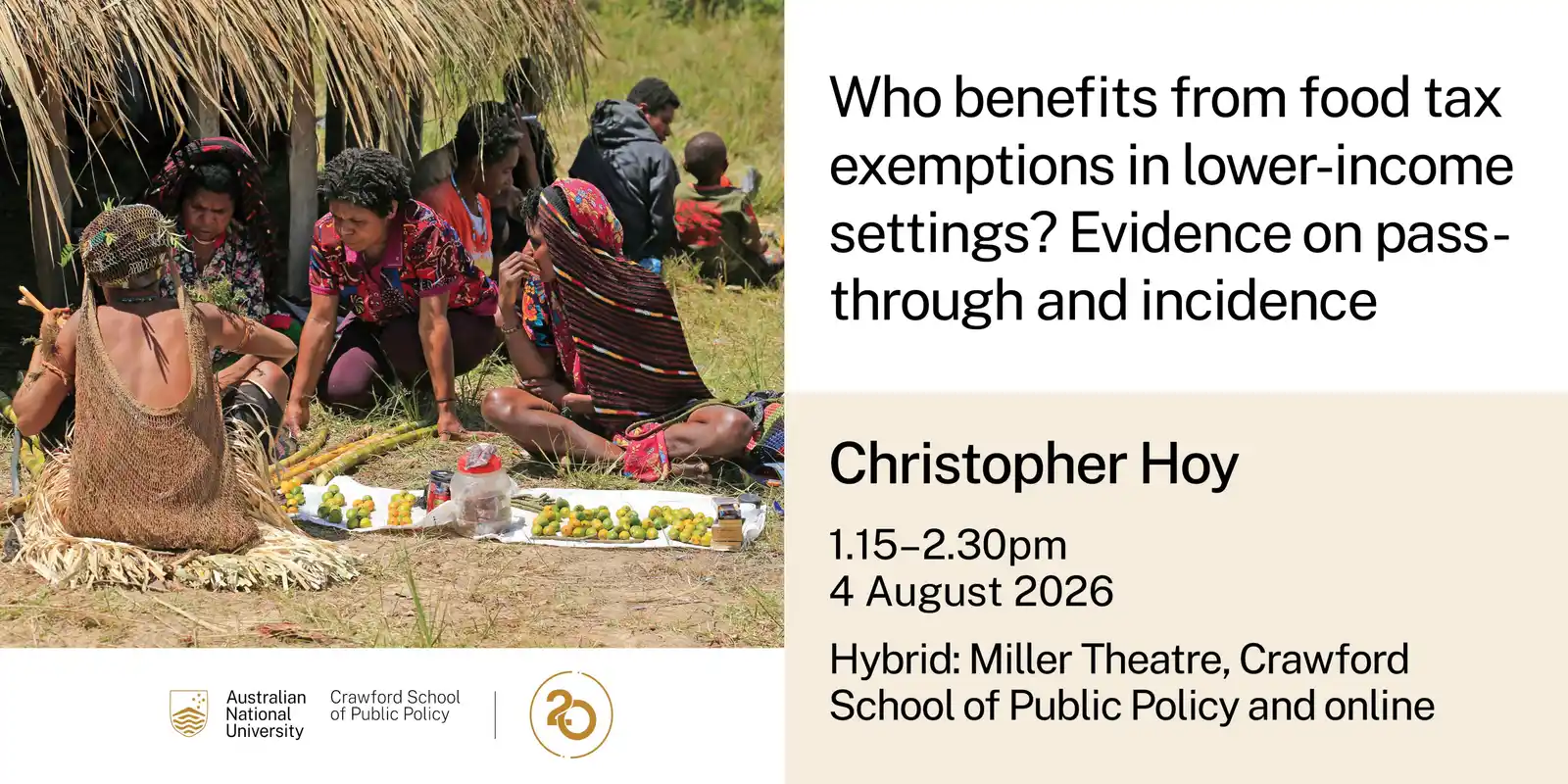
Who benefits from food tax exemptions in lower-income settings? Evidence on pass-through and incidence
- Tuesday 04 August 2026, 1:15 PM - 2:30 PM
- 73 Lennox Crossing, Acton ACT 2601
- Book Ticket
- View Website
Tax exemptions for basic items are commonly justified as a way to lower the cost of living for poorer households. This paper studies the unanticipated removal of consumption taxes on selected food items in Papua New Guinea, using administrative price data, a supermarket price census, web-scraped online prices, and a nationally representative household phone survey panel. The authors find complete pass-through in formal supermarkets in central urban districts, where retail competition is strong, but no pass-through in informal stores or rural areas, where poorer households mainly shop. Only 16 percent of the foregone revenue accrued to the poorest two quintiles, while the richest two quintiles and stores/wholesalers each captured almost 40 percent of the benefits. The paper shows that food tax exemptions can be highly regressive in lower-income settings because of informality, market segmentation, and positive income elasticity of demand for basic food, and it compares their effectiveness with alternative policies such as cash transfers.
Online attendees: Zoom link will be included in confirmation email upon registration.
Please Note: Event details may change. Please verify all information using the ticket, website, or contact details provided above. Everi is not liable for inaccuracies or losses due to changes.